Across cultures and throughout history, humans have sought to understand what we might broadly call life force energy—the invisible force that brings the body to life, nourishes consciousness, and connects us to something greater.
Taoist traditions speak of Qi, while yogic traditions speak of Prana and Kundalini. Ancient Egyptian thought offers the concept of the Ka. Across Polynesian cultures, Mana evokes sacred power and presence, while certain Algonquian traditions speak of Manitou. In Hebrew, Ruach brings together the meanings of breath, wind, and spirit.
These concepts are not identical, nor do they belong to a single universal system. They emerged from different cultures, time periods, and ways of understanding existence. Yet they all seem to point toward a shared intuition: the visible world is not inert. Life is animated by something more—a breath, a vitality, a presence, or a sacred intelligence that connects us to one another and to the source of life itself.
Qi: Cultivating Flow and Balance
In Taoist traditions, Qi represents the vital breath or life force that moves through both nature and the human body.
When Qi flows freely, it supports balance and vitality. When it becomes stagnant or disrupted, it may be experienced as tension, imbalance, or a loss of momentum.
Taoism does not simply seek to accumulate this energy, but to cultivate a harmonious relationship with it. Qi continually transforms through the complementary movements of Yin and Yang: inwardness and expansion, rest and action, receptivity and impulse.
It is not about choosing one over the other, but recognizing their constant dance within us.
Prana: The Breath of Life
In several Indian traditions, the word Prana also refers to a vital force. It is intimately connected to the breath, yet it is not limited to the air we breathe.
Prana is understood as that which animates the body, the senses, and the mind. According to yogic teachings, it moves through a subtle network of energy channels called nadis.
This is one reason why breath plays such an important role in yoga and meditation. Breathing consciously is not only a way of bringing oxygen into the body. It can also shift our inner state, calm the nervous system, and deepen our presence.
We sometimes experience this without ever using the word Prana: a deep breath that suddenly creates more space, a sigh that releases tension, or a sensation of warmth moving through the body.

Kundalini: The Union of Energy and Consciousness
Kundalini is sometimes confused with Prana, but it refers to something more specific. In certain yogic and tantric traditions, it is understood as a manifestation of Shakti—the creative and dynamic power of the divine present within every being.
It is symbolically represented as a sleeping serpent coiled at the base of the spine. This image evokes a latent potential: a transformative force that remains silent until the conditions allow it to awaken.
Depending on the lineage, Kundalini may be awakened and guided through different spiritual practices, including meditation, mantra, breathwork, and yogic disciplines. Its ascent through the central channel and the various chakras represents the gradual opening of wider dimensions of consciousness.
In the symbolic language of Tantra, this movement culminates in the union of Shakti, creative energy, with Shiva, pure consciousness. Their union represents the dissolution of separation between the individual and the universal, body and spirit, the human and the divine.
A Kundalini awakening cannot therefore be reduced to an intense sensation, a movement of the body, or a spectacular experience. Above all, it describes a profound process of transformation, integration, and recognition of the consciousness that lives within us.
Ka: The Life Force of Ancient Egypt
In ancient Egyptian thought, the Ka represented the life force that animated a human being. It formed part of a complex understanding of the person that extended beyond the physical body and encompassed several dimensions of existence.
After death, the Ka was believed to continue its existence and was symbolically nourished through offerings. Statues and representations of the deceased could also serve as its dwelling place, maintaining a connection between the world of the living and the afterlife.
Ancient Egyptian religion is no longer practised today as a dominant tradition passed down without interruption. The Ka nevertheless remains an important concept in Egyptology and continues to inspire certain contemporary spiritual movements seeking to reconstruct or reinterpret ancient Egyptian beliefs.
This understanding invites us to consider that, for the ancient Egyptians, life was not limited to the visible existence of the body. Something vital and invisible also formed part of a person’s identity.

Mana and Manitou: The Sacred Presence Within the Living World
In several Polynesian cultures, particularly Māori and Hawaiian traditions, Mana evokes spiritual power, essence, or presence. It may be expressed through a person, an ancestor, a place, or the natural world itself. Mana is therefore not simply an inner energy; it also speaks to relationship, authority, responsibility, and the sacred nature of life.
In certain Algonquian traditions, the word Manitou evokes a spiritual presence or power manifested through living beings, nature, places, and events. Kitchi Manitou, often translated as the “Great Spirit,” refers more specifically to a creative and universal spiritual reality.
These concepts do not necessarily describe an energy circulating through the body in the way Qi or Prana might. Instead, they remind us of another ancient intuition: the world is not inert. Life, the Earth, and all beings are permeated by a presence with which we are continually in relationship.
Ruach and Divine Breath: When Life Comes from God
In Hebrew, the word Ruach can mean breath, wind, or spirit. This association between breath and the divine can also be found in the Greek word pneuma and the Latin spiritus, from which the English word “spirit” originates.
In the Christian tradition, however, the Holy Spirit is not understood as an impersonal energy. The Holy Spirit is the living presence of God—one who inspires, transforms, and breathes life into creation. Breath, wind, and fire become symbols through which an invisible presence may be evoked: something we cannot grasp, yet whose movement we may sometimes feel.
Jewish mysticism and Kabbalah also speak of Shefa, the divine flow that emanates from the infinite source and unfolds through the Sefirot into the manifest world. The Shekhinah, meanwhile, evokes the divine presence dwelling within creation.
Here, life force is no longer simply an energy that human beings possess or circulate. It becomes a breath received—a presence that continually sustains existence.
Once again, these concepts are not equivalent to Qi, Prana, or Kundalini. Yet they reveal a deeply resonant intuition: life does not arise solely from within us. It moves through us, animates us, and connects us to its source.
A Shared Intuition, Different Traditions
Qi is not exactly the same as Prana. Kundalini is not simply another name for the Ka. Mana, Manitou, Ruach and the Holy Spirit carry meanings that extend far beyond the idea of energy itself. Each of these concepts belongs to a tradition with its own language, practices and understanding of the world.
Bringing them together does not mean treating them as interchangeable.
Still, it is fascinating to realize that long before we could observe electrical activity in the brain, measure the heart’s electromagnetic field, or understand the workings of the nervous system, human beings were already exploring their inner worlds.
They felt the breath, subtle currents, vibrations, altered states of consciousness, and transformations within the body. They then created symbols and systems to give meaning to what they experienced.
Perhaps these traditions are not all describing exactly the same thing.
Perhaps they are revealing different facets of a shared mystery: the intelligence of life expressing itself through us.
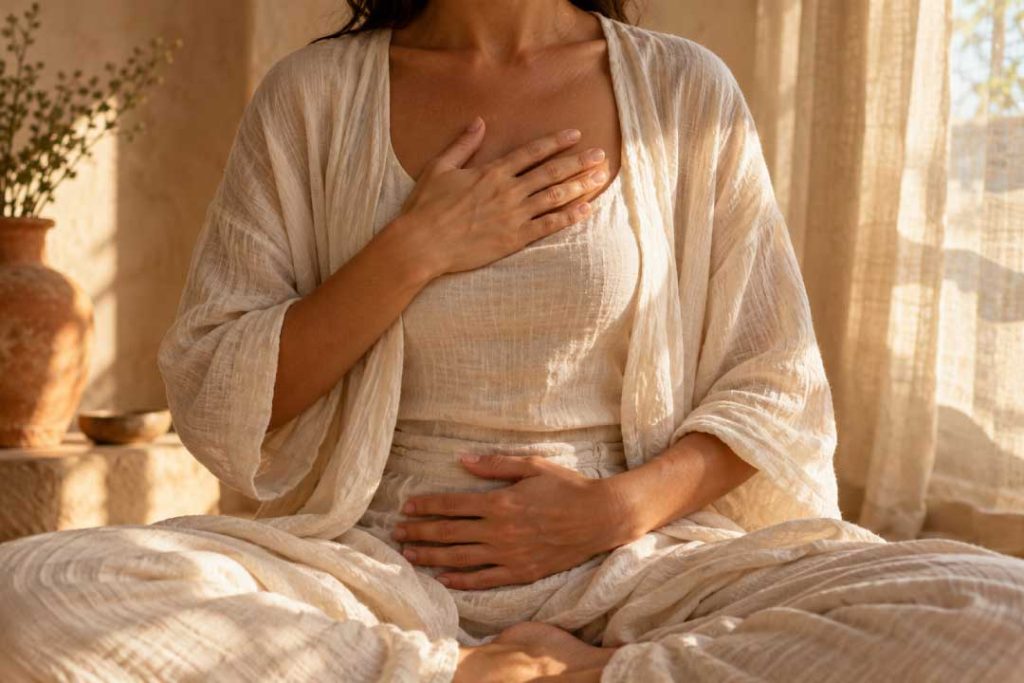
Feeling Before Understanding
In a Sacred Energy Activation session, we are not seeking to impose a belief or reproduce any particular tradition.
Instead, we create the conditions that allow the body to slow down, open, and listen.
Some people experience waves of warmth, tingling sensations, or spontaneous movements. Others encounter emotions, images, profound silence, or a sense of inner spaciousness. Some perceive very little in the moment, while a more subtle shift continues to unfold afterward.
There is no need to immediately decide whether it is Qi, Prana, Kundalini, or simply a natural response of the body and nervous system.
We can leave room for mystery.
Because some things do not ask to be understood first. They ask to be felt.
What if these traditions, through different languages, are all attempting to describe a dimension of life that we may not always be able to explain—but that we can sometimes feel?